
Intelligent Structuring in a Post–June 2024 Tax Era
When Tax Laws Change, Strategy Must Evolve.
In the June 2024 Budget, the government formalized definitions that reshaped debt investing.
- Equity Mutual Funds: 65% or more equity exposure
- Debt Mutual Funds: 65% or more debt exposure
Anything above 65% equity continues to enjoy equity taxation.
But once a fund crosses 65% allocation to debt, gains are now taxed at slab rates — removing the earlier tax efficiency that debt mutual funds once offered.
For investors in the 25%–40% tax brackets, this materially reduces post-tax returns.
The Third Category That Emerged
A new opportunity lies in funds that:
- Do not have 65% equity
- Do not have 65% debt
These fall into a separate taxation framework:
- If held less than 2 years → Slab rate taxation
- If held more than 2 years → 12.5% long-term capital gains tax
One such structure is – Income Plus Arbitrage Fund.
What is an Income Plus Arbitrage Fund?
An Income Plus Arbitrage Fund (I+A Fund) is structured as a Fund of Funds that allocates:
- 60% to high quality debt instruments such as Government Securities, Government companies and Corporate Bonds which focus on capital protection & stability
- 40% to Arbitrage Funds which capture price differences between cash and futures markets. Arbitrage behaves like debt – Consistent, Low Volatility and Returns not linked with equity market direction.
This makes the overall structure consistent and stability-oriented.
Based on current assumptions:
Income + Arbitrage Fund – Expected Performance |
|||
|
Fund |
Expected Returns |
Allocation |
Expected Performance |
|
Debt Mutual Fund |
6.50% |
60% |
3.90% |
|
Arbitrage Fund |
5.75% | 40% |
2.30% |
|
Total |
6.20% |
||
On the surface, this appears similar to Fixed Deposit returns.
The difference emerges after tax.
Fixed Deposit vs Income Plus Arbitrage Fund
Let’s compare post-tax outcomes:
Fixed Deposits vs. Income + Arbitrage Fund – Post-tax Returns |
|||
|
Investment |
Gross Returns | Tax Rate |
Post-tax Return |
|
Fixed Deposits |
6.50% |
25.00% |
4.88% |
|
6.50% |
40.00% |
3.90% |
|
|
Income + Arbitrage Fund |
6.20% |
12.50% |
5.43% |
This comparison shows how taxation impacts final returns.
A 6.5% FD return reduces to 4.88% or 3.90% depending on the tax slab, whereas a 6.2% Income + Arbitrage return results in 5.43% post-tax due to the lower 12.5% tax rate.
Even with a slightly lower gross return than FD, the Income Plus Arbitrage structure delivers superior post-tax outcomes due to:
- Lower tax rate after 2 years
- Tax deferral until redemption
The Compounding Advantage
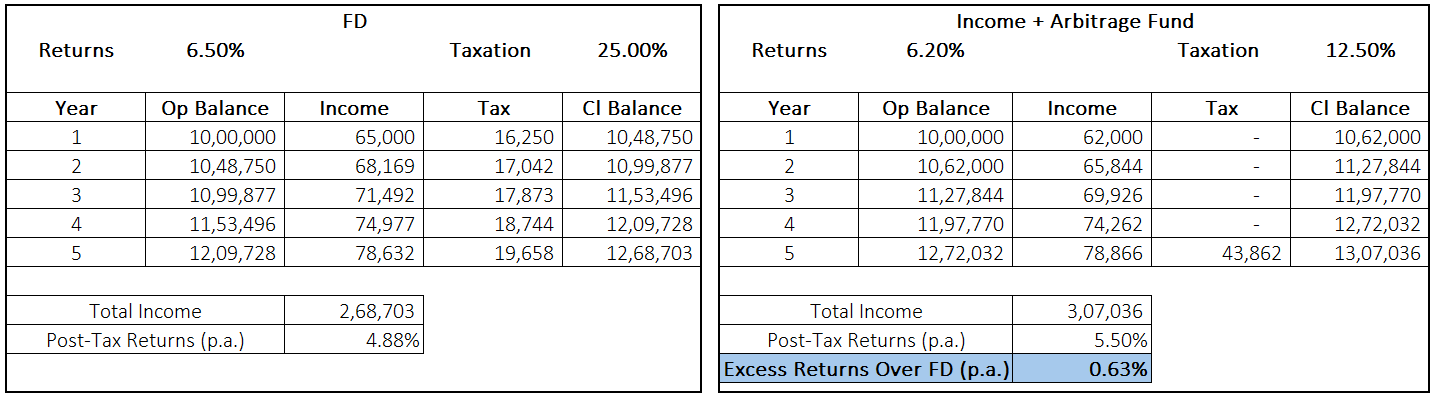
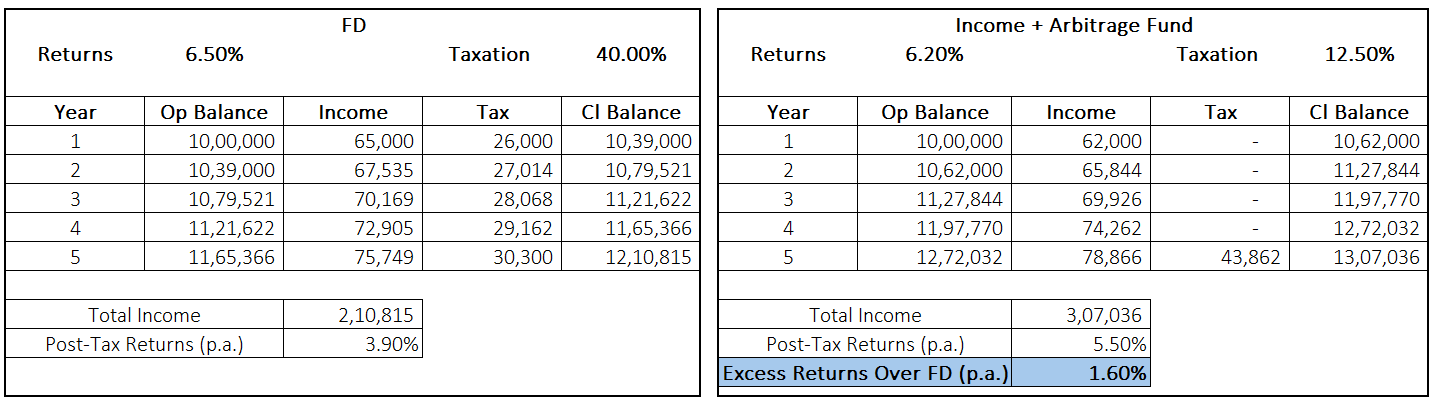
Fixed Deposits are taxed every year.
Income Plus Arbitrage Funds are taxed only when redeemed.
This allows capital to compound pre-tax.
Illustrative 5-year comparison:
- At 25% slab → ~0.63% excess annual return over FD
- At 40% slab → ~1.60% excess annual return over FD
Over longer holding periods, this difference compounds meaningfully.
Liquidity & Operational Considerations
- Redemption: 2 to 3 working days
- No lock-in period
- Flexible investment and withdrawal amounts
Income Plus Arbitrage Funds fit perfectly for:
- Medium-term goals
- Long Term Debt Allocation
- Corporate treasury allocation
Why This Structure Matters Now
The June 2024 changes reduced the attractiveness of traditional debt mutual funds but intelligent structuring restores efficiency. This allocation is designed to optimize post-tax returns over a medium-to-long-term horizon through:
- Tax deferral
- 12.5% long-term capital gains rate
- Consistent, low-volatility return profile
- Better compounding
Higher returns don’t always require higher risk. Often, they simply require smarter structuring!
Disclaimer: The returns shown are indicative in nature and are based on historical data and/or illustrative assumptions. Past performance may or may not be sustained in the future and are not a guarantee of future returns.
Mutual Fund investments are subject to market risks. Please read all scheme-related documents carefully before investing.
The information provided herein is for general informational purposes only and does not constitute investment advice, financial advice, trading advice, or any other form of recommendation. Nothing in this content should be interpreted as an offer, solicitation, or endorsement to buy, sell, or hold any financial instrument or security. Investors are advised to do proper consultations before making any investment decisions.